
How Wang-Fo Was Saved
hanne tierney
performances: October 18 - November 10, 2001,
Thursdays + Fridays, 7pm — Saturdays, 7pm + 9pm
How Wang-Fo Was Saved (for Hao Wang)
Based on the short story by Marguerite Yourcenar
Constructed and performed by Hanne Tierney
A collaboration with composer/musician Jane Wang and light designer Trevor Brown
Narrator - Andrew Pang
Voice for the emperor - Richard Clarke
Second manipulator - Mia Wiesenthal
Dialogue written and spoken - Hanne Tierney
Music composed and performed - Jane Wang
Light design - Trevor Brown
Sound design - Quentin Chiappetta
Video design - Stefanie Fischer
Light operator - Mel Besaw
Production manager - Phil Soltanoff
Help and assistance from Ondine Galsworth, Andrea Kapsales, Shawn Lane, Willie Manuel, Richard Nonas, Janee Pittman, Joe Piazzo, Daniel Schirm, Grant Smith.
Over the last two decades Hanne Tierney has developed an abstract theater, a continuation of the Symbolist’s and early Modernist’s search for a theater without actors. In Tierney’s radical solutions her performers can be two dimensional geometric shapes (as in Flatland, with Jene Highstein for BAM’s Artists-in-Action series) or sensuous fabrics and stainless steel coils (as in Oscar Wilde’s Salome, presented by the Henson Festival at Danspace last year). How Wang-Fo Was Saved is Tierney’s latest work. Her performers are bamboo fronds, silks, stiffened robes and glowing lanterns. They are manipulated through a counterweight stringing system of 114 strings, performed by Tierney like a complex harp and in full view of the audience. The gestures and subtle movements of Tierney’s figures convey profound and intense human feelings with a strangely unmediated immediacy that human actors inevitably deflect. The melancholy of the concubines, the wife’s loneliness, the disciple’s frustration with his lack of talent and Wang-Fo’s passion for art are felt here as almost palpable physical presences. Hanne Tierney’s adaptation of this ancient Chinese legend, based on a version by Marguerite Yourcenar, celebrates the triumph of art over life, or the supremacy of art over everything.
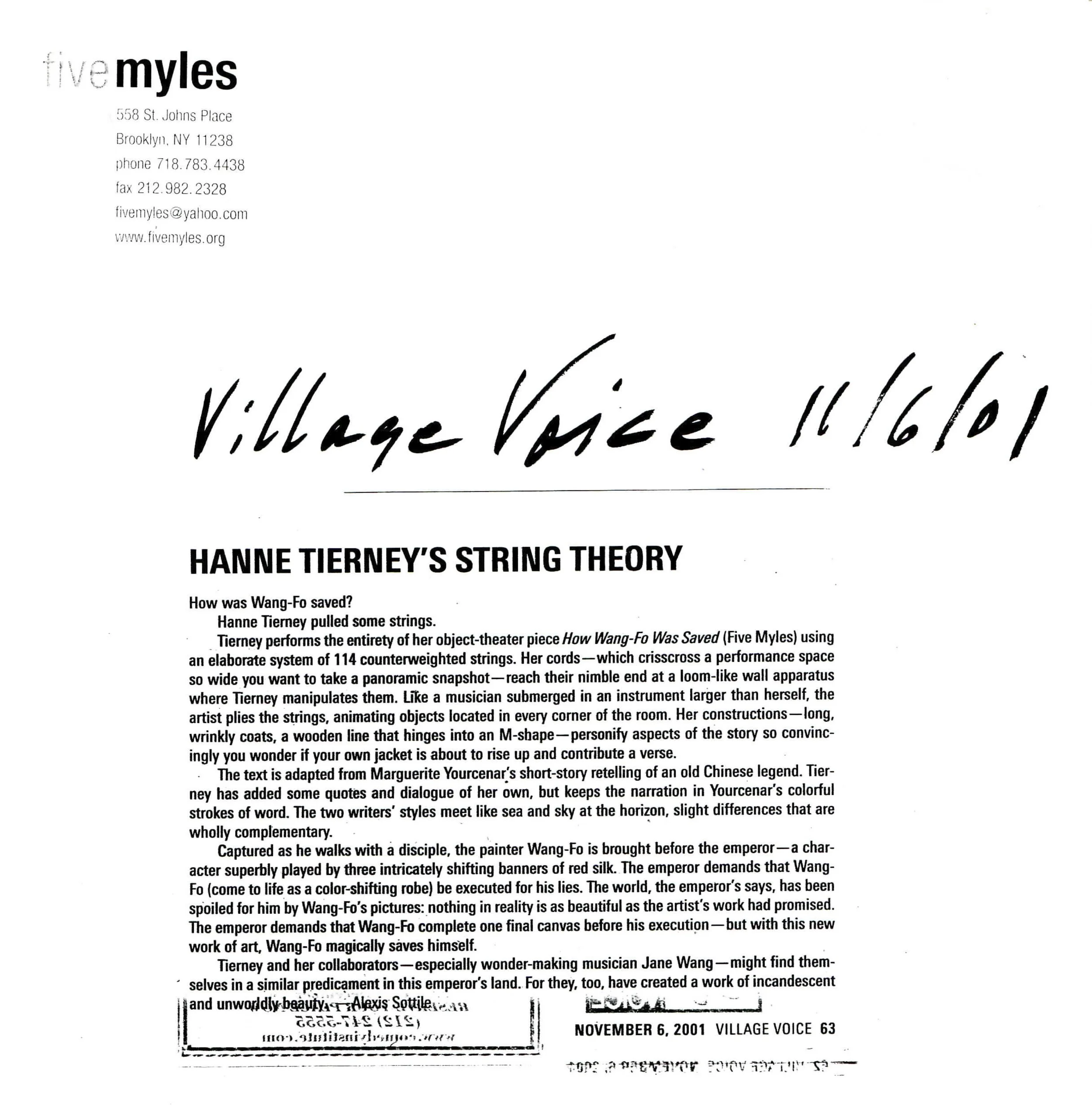
The old painter Wang-Fo, forced by the emperor to finish one last canvas before his execution, first paints a lake, then draws a rowboat, and as the waters rise and fill the throne room, he climbs into the boat and rows off. Excerpts from Marguerite Yourcenar’s text are narrated by the actor Andrew Pang. Tierney speaks the characters’ dialogue while performing the strings ina seamless coordination of spoken words and movement. German video artist Stefanie Fischer ends the work by engulfing the audience in Wang-Fo’s rising flood. Composer/musician Jane Wang accompanies the action with a mixture of her own compositions on the double bass and the faux Chinese music she performs with colorful plastic tubes, small cooking utensils from Chinatown and her voice. (Jane Wang performs with All Nationalities of Women Sextet, the Satako Fujii Big Band among others, and can be heard on the Lydian People’s Front CD. She composed and performed the music for Tierney’s The Seagull, Blood Wedding, and Salome with Sabir Mateen.
Hanne Tierney has received several awards for excellence from UNIMA (Union International de la Marionette), most recently for Salome. She was awarded NEA grants for Solo Performance and has been supported by the Fund for US Artists and the Jim Henson Foundation. She has performed internationally at the Sydney Biennale, Akademie der Kuenste in Berlin, at Bitef in Belgrade, Espace Kiron in Paris and theater festivals throughout Europe. In New York she has performed at the Guggenheim and Whitney Museums, the Sculpture Center, The Kitchen, five myles and at three Henson International Festivals of Puppet Theater.
How Wang-FoWas Saved is funded by a mid-career grant from the Jerome Foundation and a grant from the Jim Henson Foundation.
DIRECTIONS:
Take 2, 3, or 4 trains to Franklin Avenue. Walk two blocks against the traffic on Franklin. Walk ¾ block to 558 St. Johns Place. FiveMyles is within easy walking distance from the Brooklyn Museum.